

Government procurement is essential to modern governance. But when firms rig bids, allocate markets, or otherwise collude, taxpayers pay more, honest competitors are shut out, and trust erodes. In recent months, US agencies have continued to emphasize the importance of fair competition in government procurement, scrutinizing regulations that may favor incumbents or unfairly limit competition and expanding whistleblower options.
Enforcement isn’t just about chasing down wrongdoers; it’s also about preventing harm in the first place. Relying on that justification, the Department of Justice (DOJ) Antitrust Division and the Federal Trade Commission (FTC) submitted recommendations to the White House for deleting or revising regulations that are anticompetitive, including in a procurement‐related context. The recommendations included eliminating the Department of Transportation rules that give preferences to “socially and economically disadvantaged individuals” in awarding transportation contracts, policies that, while well intentioned, may have the effect of excluding bidders that are otherwise competitive on merit.
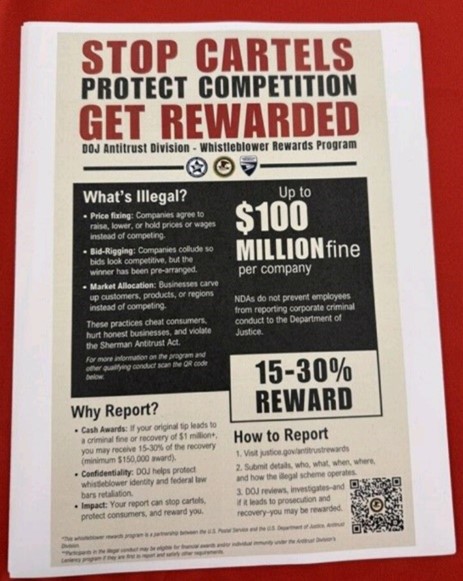
One of the most striking recent developments is the DOJ’s new Whistleblower Rewards Program, announced in July 2025. Under the program, individuals who report antitrust crimes or related wrongdoing, including bid‐rigging, price fixing, and other procurement abuses, may receive monetary rewards. The idea is simple but powerful; many illegal schemes remain hidden unless insiders come forward. The poster in the image captures this message clearly—“Stop Cartels. Protect Competition. Get Rewarded.” It highlights the DOJ’s focus on empowering insiders to report illegal conduct even if nondisclosure agreements exist. This creates a fresh channel for exposing corruption in public contracts.
These moves show a dual approach—root out anticompetitive conduct for prosecution and dismantle structural regulatory barriers that may encourage or enable such conduct.
For contractors and procurement officials, this means compliance programs are more important than ever. It’s no longer enough to avoid blatant wrongdoing; firms should evaluate whether their practices (or the regulations they rely on) might inadvertently put them on the wrong side of the DOJ or the FTC.
Antitrust enforcement in procurement is getting tougher, more creative, and more far‐reaching. Between whistleblower incentives, criminal prosecutions, and regulatory cleanups, the federal government is sharpening its tools. For those involved in procurement, it’s time to review contracts, check compliance, and ask themselves “Are we promoting competition or unintentionally restricting it?”
Here are six steps your company can take today to reduce antitrust risk.
- Create a Culture That Reduces Whistleblowing Risk
- The most effective way to minimize external whistleblowing is to build a workplace culture where employees feel heard, respected, and safe when raising concerns internally. Companies should establish clear compliance policies, offer anonymous reporting channels, and respond promptly to concerns with transparency and accountability. Regular training reinforces expectations and shows employees that their leadership values ethical conduct. By addressing issues early and fairly, businesses foster trust, which greatly reduces the likelihood that employees will feel compelled to report problems to those outside the organization.
- Build Accessible Internal Reporting Channels
- Employees are far more likely to raise concerns internally if the process is clear, simple, and available in multiple formats (e.g., hotline, web portal, open-door policy). Options to remain anonymous are critical so that staff feel protected when voicing sensitive issues.
- Act Quickly and Transparently
- Train and Empower Managers
- Direct supervisors are often the first point of contact. Equip them with training on how to listen, document, and escalate concerns without defensiveness or retaliation. Reinforce that retaliation is prohibited by law and company policy.
- Reinforce an Ethical Culture
- Go beyond policies by weaving compliance and ethics into daily business practices. Regular reminders from leadership, recognition for employees who demonstrate integrity, and case studies in training all help normalize speaking up.
- Close the Loop with Feedback
- When an issue is raised, follow up with the reporting employee, where possible, to explain what steps were taken. Even if a concern doesn’t lead to corrective action, acknowledgment and respectful communication build trust and reduce frustration.
By implementing these practices, companies not only reduce the risk of external whistleblowing but also improve organizational resilience, strengthen compliance programs, and build long-term trust with employees, regulators, and customers.